

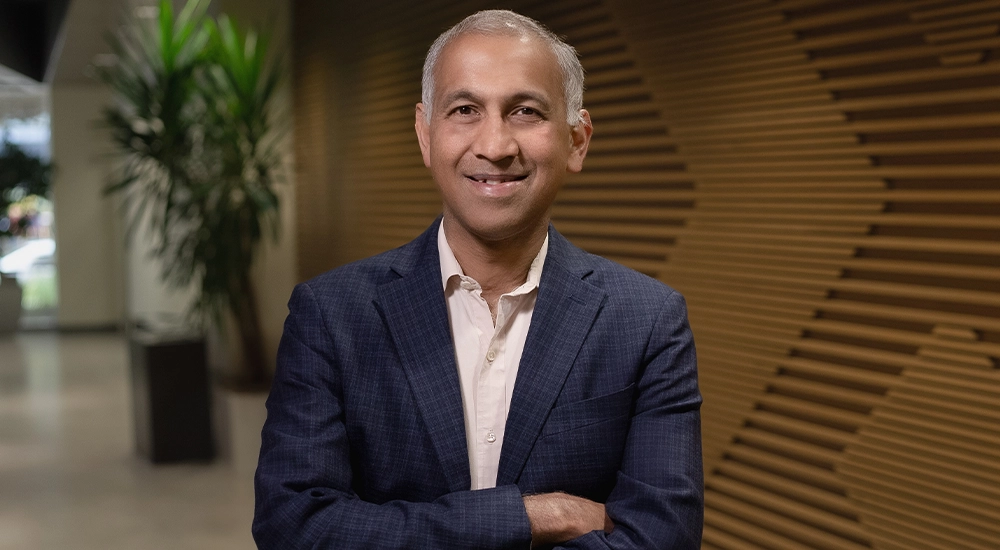
In this exclusive interview with GEC Newswire, Nutanix President and CEO Rajiv Ramaswami breaks down the misconceptions around cloud and the realities of infrastructure modernisation
Nutanix has evolved from hyperconverged infrastructure to a hybrid multi-cloud platform. How do you define Nutanix’s core mission? What are the pain points you’re solving for your customers?
Our core mission is to enable our customers to run their applications and manage their data wherever they choose to do so. And today, that really means across many different environments. Customers may be running applications in their own data centres, at the edge, in public clouds—sometimes a single public cloud, sometimes multiple public clouds—through service providers, and increasingly in sovereign cloud environments.
What Nutanix does is provide a platform that customers can use consistently, regardless of where those applications and data are running. This is truly what we mean by hybrid and multi-cloud. Customers have their data and applications everywhere, and we enable them to operate all of that in a very simple and easy manner.
We were a Silicon Valley startup that went public a while ago. Today, we are close to $3 billion in annual revenue, and growing nicely. We have around 30,000 customers globally, and we’re adding roughly 600–615 new customers every quarter.
One of the things I like to emphasise about Nutanix is our culture and the way we fundamentally operate. We have four core cultural principles. The first is that we obsess over our customers’ success, and that mindset is built into every employee from day one. The proof, by the way, is that our customer Net Promoter Score has remained around 90 for the last ten years, even as we’ve grown significantly as a company. I think that’s a real testament to how seriously we take the idea that your success is our success, and we remain fully committed to investing in that going forward.
The second principle is long-term commitment. We are here to build enduring partnerships with our customers. We don’t view these as transactional relationships; instead, we want to continue building, continue serving, and continue evolving alongside you. That philosophy also guides how we invest in our own company. We reinvest about 25% of our revenue back into R&D, which is among the highest levels in the technology industry.
The other two principles, briefly, are that we operate as one team internally, and that we are a highly distributed accountability company. Everyone is empowered, everyone owns outcomes, and responsibility is shared across the organisation. Those are the cultural foundations of the company.
You’ve said that cloud-native is an operating model, not a location. How important is it to make the distinction between cloud-native and public cloud?
Yeah, I think it’s very important. Both terms, cloud and cloud-native, are often misused. They don’t represent a physical location; they represent how you operate.
Cloud is really about running a fully automated, software-defined environment, where infrastructure can be provisioned and deployed entirely through software. That environment can exist in a public cloud, in a private data centre, at the edge—it can exist anywhere.
The same is true for cloud-native. Cloud-native refers to how applications are built—designed for massive scale, built using microservices, capable of scaling easily, and deployed in a modern, automated way. Cloud-native applications can also run anywhere: in public clouds, on-premises data centers, or at the edge. Increasingly, many AI applications will also be cloud-native.
So when we talk about hybrid, we’re really talking about how you operate your infrastructure and how you build your applications—not where they physically reside.
What do you see as the biggest technological barriers to infrastructure modernization today?
Look, there’s a lot of inertia out there. We’ve been talking about infrastructure modernisation for many years, yet there is still a tremendous amount of legacy infrastructure in place. And in many cases, the reason is simple—it works.
People don’t always realise that by modernising, they can achieve massive improvements in sustainability. They can dramatically reduce power consumption, improve performance and throughput, simplify operations, and run their environments with far fewer people. Most importantly, they can prepare themselves for a future driven by AI and modern applications.
What keeps organisations tied to their current environments is that sense of comfort—this infrastructure works, it’s familiar, and it’s been in place for many years. That inertia is the biggest barrier.
AI has exposed hidden complexity in infrastructure. Is it forcing CIOs to rethink how they evaluate private cloud, on-prem, and hybrid cloud models?
AI is absolutely triggering a new wave of infrastructure modernisation. You need modern infrastructure to run AI applications effectively. At the same time, AI is forcing organisations to rethink where those applications should run.
Just like other workloads, AI will be hybrid. It will run where the data resides. If you’re comfortable placing your data in the public cloud, then running AI there makes sense. If you want stronger control, security, and protection of your intellectual property, then running AI in a private cloud becomes the better option.
Ultimately, AI workloads will run everywhere—across public clouds, private clouds, and hybrid environments, based on where organisations choose to keep their data and how they want to govern it.
What is your message to the CIO community in this part of the world?
Nutanix is deeply invested in this region. We’ve been operating here for a long time, and we want to be your trusted partner for the next five to ten years.
As you modernise your infrastructure, adopt hybrid cloud strategies, deploy sovereign cloud environments, build modern applications, and run new AI workloads, we want to be there with you every step of the way.