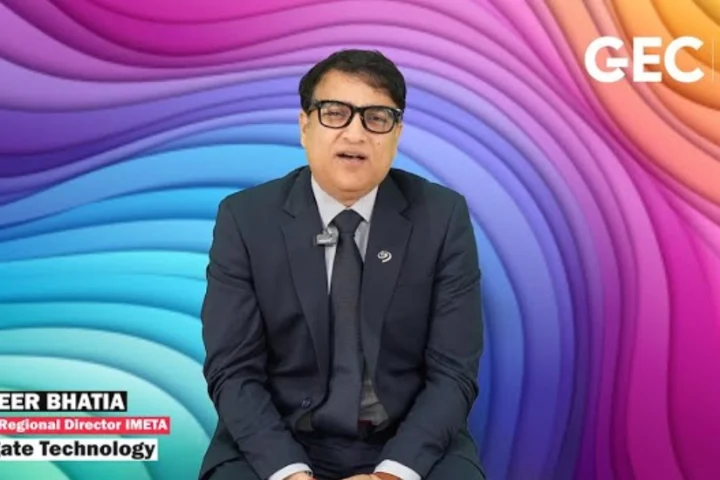


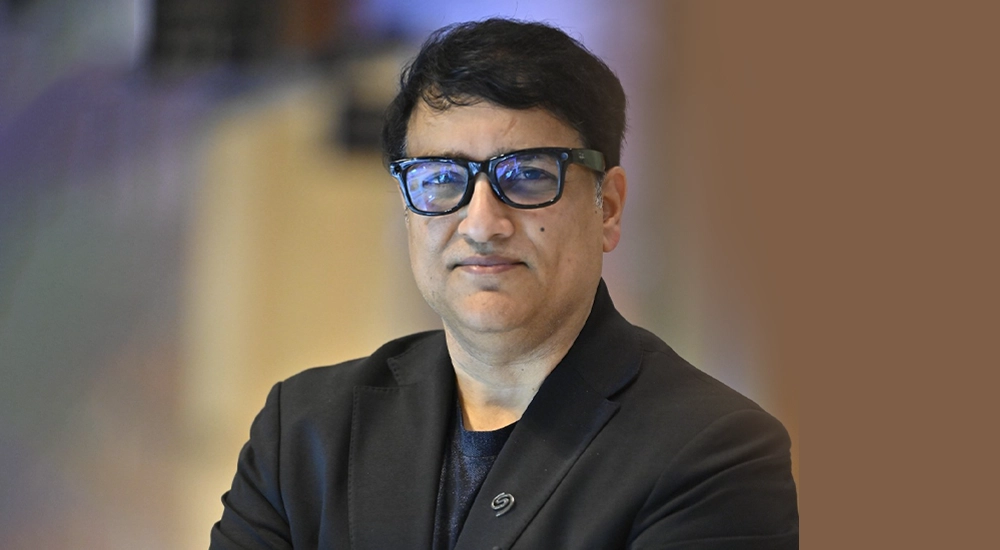
Sameer Bhatia, Senior Regional Director – India, Middle East, Turkey and Africa at Seagate Technology, speaks to GEC Newswire at Intersec UAE 2026 on the evolving role of high-capacity storage in AI-driven surveillance, security, and critical infrastructure.
- What is the main message Seagate is bringing to Intersec 2026, and how does it reflect the changing role of storage in security and critical infrastructure?
I’m very happy to be here. First of all, Intersec has always been very important for Seagate as a platform where we meet our customers, distributors, and channel partners, and where we showcase our products and technologies—both for the near term and for the future.
This year, we are also the official storage partner at Intersec. Beyond the AI data surge that everyone is talking about, we are launching our 32TB SkyHawk hard drive. SkyHawk is our dedicated surveillance brand, and just an hour ago, we launched the industry’s first 32TB hard drive designed specifically for video imaging applications.
- Video is moving from passive surveillance to decision-grade intelligence. How is this shift changing the way organisations need to think about data infrastructure?
The world is changing, and because of that, many things need to be done differently. While we have been doing things a certain way in the past, the AI era has brought an unprecedented demand for high-capacity storage – especially for video imaging applications.
With the adoption of 4K and 8K recordings, high-definition cameras, and the need for better frame rates and image quality, the requirement for higher-capacity storage has increased significantly. Earlier, with lower frame rates and lower video quality, 2TB, 4TB, or 6TB drives were sufficient. Today, we are seeing a growing need for much higher capacities.
We work closely with partners in the region such as Hanwha and Hikvision, and we’ve already seen demand grow for 16TB and 20TB drives. As mentioned, today we launched a 32TB hard drive, and CXOs and CIOs are already discussing their future storage needs with us. Hard drives remain the answer to these requirements.
We have also been working on a technology called HAMR, which powers our Mozaic drives. HAMR stands for Heat-Assisted Magnetic Recording. With HAMR, we can store significantly more data in the same 3.5-inch form factor.
To put it into perspective, imagine an 8TB hard drive and today a 32TB hard drive in the same 3.5-inch form factor. This makes storage more efficient and more sustainable. These drives consume less power and energy, which also benefits the overall carbon footprint.
That’s what Seagate is focused on.
- AI and computer vision are adding metadata, summaries and analytics to every video stream. What impact is this having on storage capacity, architecture and long-term retention?
Every CIO or CXO needs to think about their infrastructure- where they stand today, where they will be tomorrow, and what their storage landscape will look like over the next decade.
There’s an interesting data point: back in 2005, the total data generated globally was less than one zettabyte. Twenty years later, in 2024–25, we are sitting at around 75 zettabytes of data. We conducted a study with IDC that forecasts the world will generate nearly 575 zettabytes of data—almost five times what we have today.
If five times more data is going to be generated, the big question is: where will it be stored? That’s the discussion we are having with our customers, enterprises, and hyperscalers. The answer is higher-capacity hard drives.
Today, we are talking about 32TB drives. In the near future, we will be talking about 40TB drives. Our CEO has already announced plans for a 100TB hard drive. That is the direction the industry is moving toward—more storage in a compact 3.5-inch form factor.
- How do demand drivers in the UAE and Saudi Arabia differ when it comes to video analytics and large-scale data infrastructure?
Like many governments, the UAE government – and perhaps more so than others – has been at the forefront of surveillance and security initiatives. Surveillance has been a key sector in this region, and we work closely with many government organisations to support their growing data and storage needs.
Our answer to these demands is HAMR technology. HAMR-powered Mozaic drives are designed to store the world’s data in the AI era.
Storage for surveillance and imaging applications is critical – whether it’s for smart cities, airport security, medical records, or national security. A country with strong storage infrastructure, especially for surveillance, is better protected. That’s why we continue working closely with government organisations to meet their requirements.
- Beyond traditional security, where are you seeing video analytics deliver the most operational value today?
People often ask me where data should be stored. My answer is that it depends on the customer’s needs – how they want to access the data and how frequently they need to retrieve it.
At Seagate, we offer products and solutions across every layer of data storage – cloud, data centres, private networks, edge environments where data is generated, as well as consumer and external hard drives.
We give customers options at every level of data storage. Ultimately, customers must recognise the value of their data, and we provide them with the right solutions to store it.
- For organisations planning AI-driven video systems, what are the key trade-offs they need to manage between performance, scale and cost over the long term?
It’s all about scalability.
As mentioned earlier, our Mozaic HAMR drives currently deliver 32TB, and we are already working toward 40TB and 50TB drives. Organisations need to carefully assess where their capital expenditure and operational expenditure are going.
This is a capital-intensive industry, but it is also an investment in the future. The more we invest today, the safer and more efficient our environment will be tomorrow. Whether it’s enterprise investment or investment in surveillance systems, the need continues to grow, and data has become extremely valuable.
We want customers to value their data and plan for the future – how they secure it and how they access it.
It’s all about data, data, and more data in this AI era.
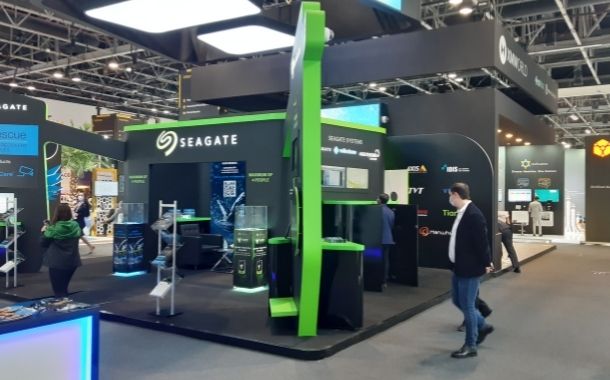
The feedback we are receiving has been extremely positive. Customers are very excited. We’ve seen strong footfall at our booth, and the launch of the 32TB hard drive has generated significant interest. People are excited to see the first 32TB hard drive available in the region.
We are now working toward shipments for the region. Overall, the excitement is clear—whether from end customers or from our channel partners who work with us every day to bring products to market.
Intersec has always been a strong platform for us, and this year has been particularly exciting. We also participated last year, but the energy this year is noticeably higher. Everyone is talking about AI. Anyone who isn’t talking about AI feels left behind.
At Seagate, however, we believe it’s not just about talking about AI – it’s about extracting real value from the data generated by AI. We are well prepared to manage and support the massive data generation happening worldwide.