

Construction has started on the 360MW opening phase, with the first capacity ready for customers in 2028.
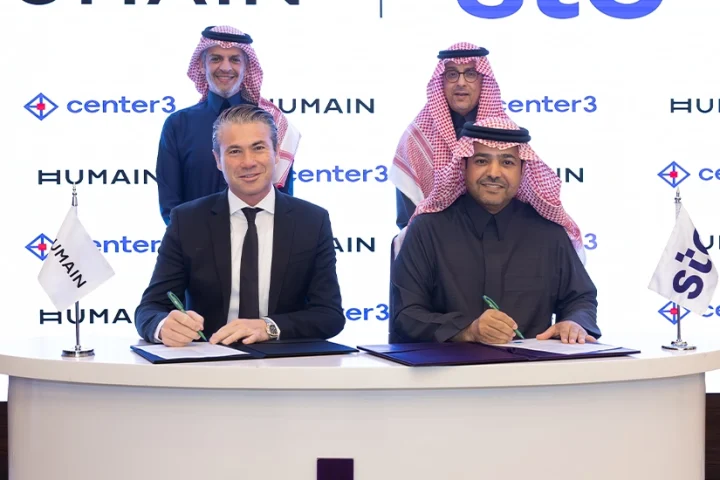
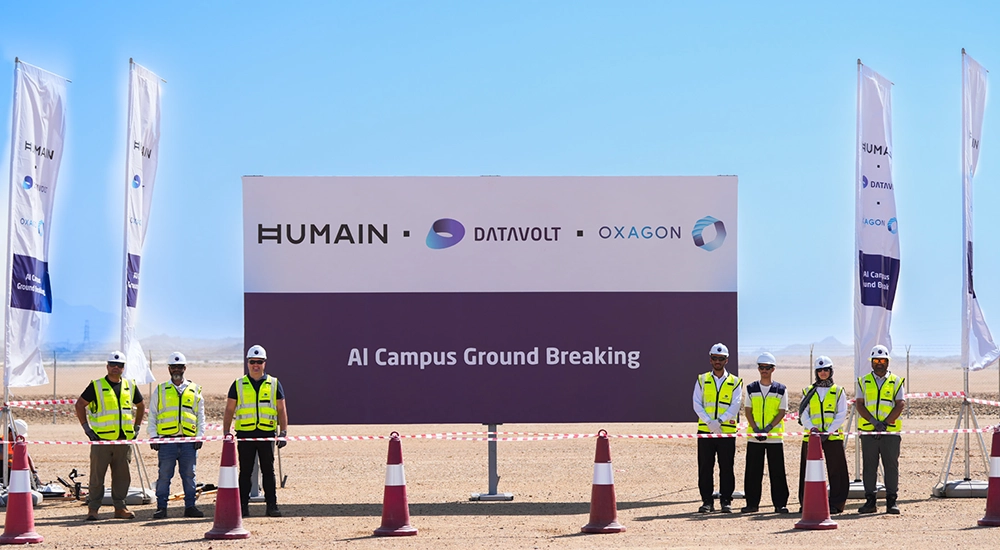
Crews are on site at Oxagon, the industrial city on NEOM’s Red Sea coast, where HUMAIN and DataVolt have started building an AI data centre designed for the compute densities that advanced model training and inference now require. The two companies announced an expanded partnership at LEAP to jointly develop 100MW of the 360MW first phase, with that initial capacity expected to be ready for service in 2028.
HUMAIN, the Public Investment Fund company delivering full-stack AI capabilities globally, brings the compute, cloud and model layer, including Arabic large language models developed in the region. DataVolt, headquartered in the kingdom with offices in the United States, Uzbekistan, India and the UAE, brings the discipline that determines whether capacity of this size arrives on schedule: power procurement, engineering, financing, construction and operations. The 360MW now under way opens a planned 1.5GW campus.
The bottleneck in AI has moved from silicon to substations, and Oxagon was picked for that reason
Tareq Amin, chief executive of HUMAIN, kept his remarks on delivery rather than ambition. “AI ambition only matters when you can turn it into infrastructure, compute and capacity that customers can use,” he said. “Construction is underway, 100MW is moving forward, and we are building with the speed and scale that the next era of AI demands.”
Rajit Nanda, chief executive of DataVolt, was specific about what separates announced projects from operating ones. “AI infrastructure at this scale demands more than capital and capacity, but disciplined execution, from power and engineering through construction and operations,” he said. The partnership, he added, brings complementary capabilities together with a focus on delivery and on bringing world-class digital infrastructure capacity to the kingdom.
Oxagon supplies the three inputs that increasingly decide where AI capacity gets built. Pre-zoned industrial land removes years from the development cycle, energy is available at scale, and subsea cable connectivity to Europe and Africa gives customers low-latency routes into two continents from a single site. Eng. Aiman Al-Mudaifer, managing director and chief executive of NEOM, put the calculation plainly. “The ability to secure the power, land and connectivity needed to grow is becoming critical to the economics of AI,” he said, describing Oxagon as bringing those advantages together for companies building the infrastructure the next generation of AI will run on.
What the campus signals to enterprise buyers planning three years ahead
The facility is designed to integrate renewable energy sources, advanced cooling and high-performance computing clusters, and to serve large-scale AI and cloud workloads from international and domestic customers alike. For CIOs in the Gulf mapping capacity requirements against a multi-year AI roadmap, the useful detail is the 2028 ready-for-service date, which gives procurement teams a fixed point to plan sovereign hosting decisions around rather than an open-ended pipeline number.
It also completes a picture HUMAIN has been assembling in public. The company’s other announcement today, a packaged AMD-powered compute product for Saudi enterprises running their first workloads, sits at the entry point of the same journey that ends at Oxagon. One gives organisations somewhere to start, the other gives them somewhere to scale.