



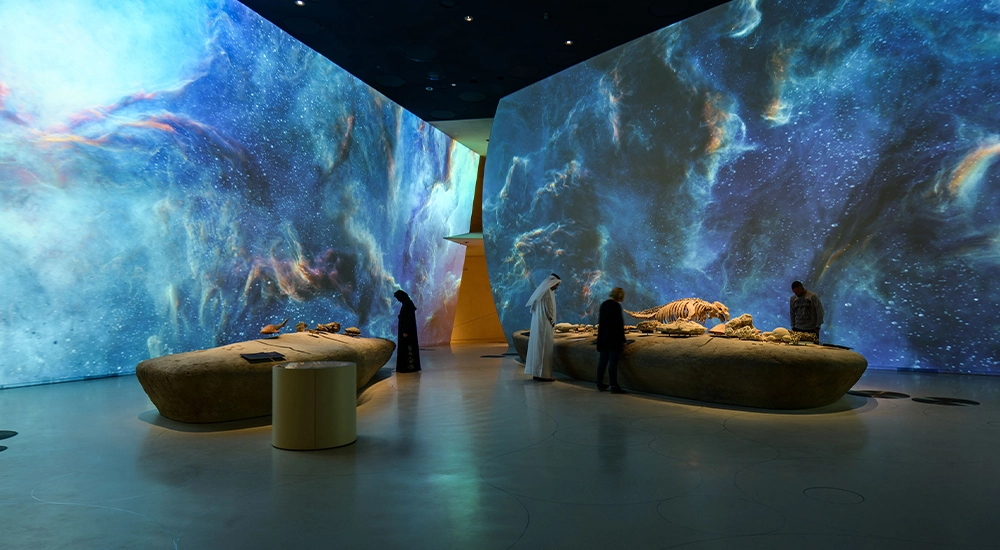
The National Museum of Qatar has overhauled its immersive visitor experience through a major technology upgrade. In partnership with HIVE and Panasonic, the museum integrated 172 media engines and 128 4K projectors to deliver over 21 billion pixels of content per second. The deployment uses HIVE’s embedded SDM technology to simplify installation and improve energy efficiency across the landmark’s galleries.
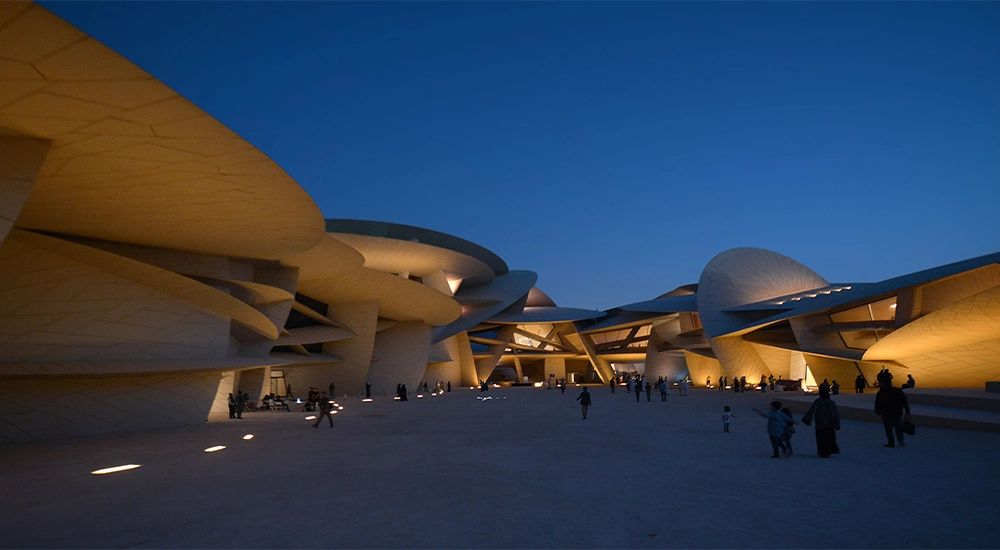
Designed by Pritzker Prize-winning architect Jean Nouvel, the National Museum of Qatar is renowned for its striking desert rose-inspired architecture and immersive visitor experience. The museum’s galleries combine cinematic projection, artefacts and exhibition design to guide visitors through Qatar’s journey from prehistoric landscapes and early settlements to the nation’s modern development and future vision.
Delivered in partnership with Secuoya QFC & BGL audiovisual, the installation represents one of the largest HIVE deployments to date, with 172 Beeblade media engines supporting projection mapping and synchronised playback across ten galleries. To bring Qatar’s history and culture to life, the museum is also currently upgrading all 128 of its Panasonic projectors to the latest PT-RQ25K 4K DLP laser technology – each equipped with HIVE’s embedded technology via the SDM slot. This approach eliminates the need for external media servers and extensive cabling, reducing installation complexity, cost and potential points of failure.
Pedro Jiménez Train, Operations Manager at Secuoya QFC & BGL audiovisual, said: “HIVE’s media servers proved to be an outstanding solution for a project of this scale and complexity. The platform is intuitive to operate, integrates seamlessly with the wider AV architecture and delivered significant rack space and installation efficiencies. What stood out most was HIVE’s collaborative, solutions-driven approach. Large-scale permanent projection environments inevitably present technical challenges, and the team consistently worked alongside us to find practical and reliable solutions throughout the project.”
At the heart of the system is a distributed playback architecture comprising 150 Beeblade Pluto media engines, 30 Beeblade Minima media engines and 14 Beehive enclosures. Together, they deliver 8K 10-bit HEVC playback, projection mapping and site-wide scheduling, ensuring synchronised content playback across the museum’s immersive galleries.
Projection alignment and blending are managed using VIOSO software, while HIVE’s platform provides centralised monitoring, reporting and control to simplify long-term operation.
The visual experience is to be delivered by 128 Panasonic PT-RQ25K 3-Chip 4K projectors installed throughout the museum’s immersive galleries, projecting cinematic content across complex curved architectural surfaces and exhibition environments. With 20,000 lumens capability, the PT-RQ25K provides approximately double the light output of the PT- RQ13K projectors being phased out as part of the upgrade programme. This additional performance headroom allows the museum to operate the projectors at substantially lower output levels while maintaining exceptional image quality.
“When the museum opened in 2019, immersive cultural attractions were still relatively rare,” said Anthony Molloy, Division Head MEA at Panasonic Projector & Display. “Today, immersive experiences are commonplace, but the National Museum of Qatar remains one of the pioneering examples of how technology and storytelling can be combined at scale. Specifically, the upgrade to PT-RQ25K projectors provides significantly greater brightness than the projectors it is replacing. This improves energy efficiency, reduces operational demands and helps extend the lifespan of the installation. Combined with HIVE’s distributed media architecture, which simplifies content management, monitoring and control across the entire site, the result is a highly efficient and future-ready platform for immersive storytelling.”
Unlike many projection-mapped attractions, visitors can approach the projected surfaces directly, placing exceptional demands on image quality and system performance. Purposely filmed for DLP content, the films, captured largely in 8K resolution using multi-rig camera systems, are projected across dynamically curved gallery walls and architectural surfaces at monumental scale, creating a seamless blend of architecture, content and storytelling.
The deployment demonstrates how modern media server technology can support large-scale immersive environments while simplifying installation, operation and long-term maintenance. Processing more than 21 billion pixels of visual content every second, the system enables the museum to deliver cinematic storytelling across multiple galleries while maintaining synchronised playback and consistent image quality throughout.
For HIVE, the project represents a major milestone and a powerful reference for immersive cultural installations worldwide. Mark Calvert, CEO of HIVE, said: “One of the biggest achievements of the project was simplifying what had previously been an extremely complex projection environment. From the visitor’s perspective the experience is visually richer than ever, but behind the scenes the system is now far easier to operate, maintain and scale long term. The National Museum of Qatar stands as a benchmark for immersive cultural experiences worldwide and we’re proud that HIVE technology plays such a central role in bringing that vision to life.”