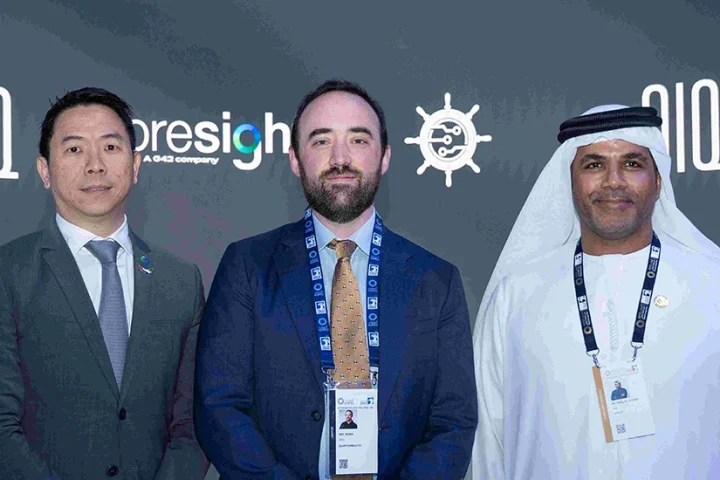




Salman Kazmi, Vice President for the Middle East, Turkey, Africa and Eastern Europe, oversees BMC Helix across 97 countries, and he says the AI conversations he has are much the same everywhere. What changes is how much organisations are willing to share, and how honest they are with themselves before they begin.
Speaking to GEC Newswire, Kazmi discussed how Helix works with enterprises at different levels of maturity, its bring-your-own-LLM approach to sovereignty, why “AI creep” has replaced scope creep, where humans will keep control of autonomous systems, and why claiming to be skilled in AI is “like saying I’m skilled in breathing.”
When you look at markets like Saudi Arabia and the UAE compared with the rest of the GCC, how does BMC Helix adapt its AI strategy for organisations at different stages of readiness?
Some organisations dealt with data quality early; others have already consolidated their systems. But the core problem for anyone on an AI or data journey is the same: a lot of manual work spread across many people, and information sitting in disconnected tools.
Every readiness conversation starts with the same question. What are you trying to achieve? You have to begin with the end in mind.
The other trap is trying to do too much. Whether people use AI personally or at work, they tend to start 20 projects at once, and three weeks later they have finished one because they are still thinking about the other 19. Enterprise IT does the same. You need one problem to fix. That might be ticket deflection, where large volumes of tickets trace back to a single underlying issue, or a flood of self-service requests that could be connected better.
Mature and emerging organisations differ in how much autonomy they can bring to operations. Companies with good data quality move into automation much faster. Those at an earlier stage need to clean their data, gain visibility and understand their workflows before they automate anything.
If you launch one use case properly, you can keep adding capability over time. If adoption is full of friction, no platform will fix that for you. You end up saying, “AI doesn’t work for my company. We’re culturally not ready. Come talk to me in 10 years when I’m a dinosaur.”
I cover 97 countries, and the conversations are much the same across all of them. What varies is how much organisations are willing to share, and how honest they are with themselves before they start.
Data sovereignty and AI sovereignty are becoming critical globally. How are you helping enterprises scale AI without compromising on compliance with local regulations?
Regulation comes down to where the data lives and who can act on it. Governance then adds three layers: what data AI is allowed to use, what actions it can take, and an audit trail of every action it has taken.
Helix has SaaS in both the UAE and Saudi Arabia, our two largest markets. We also offer a bring-your-own-LLM option for customers who don’t want their data leaving their control. The data that refines the model belongs to the customer. We pre-train our models and deliver them on-premise or as SaaS, but whatever data you put through them to improve accuracy remains yours.
Customers who want in-country SaaS in either market have it. Those who want to run their own LLMs, and several do, can. Those who want a combination, such as our SaaS alongside their own LLM on Azure in the UAE, a popular setup for data pipelines, can do that too.
Over the past seven years, as we re-architected the business to become Helix, we have avoided any kind of lock-in. We want to integrate, facilitate and respect those requirements, and we were first to market with much of this in both countries.
Many AI projects have moved past the pilot stage but are still struggling to show ROI. What separates AI that scales from projects that remain stuck in experimentation?
Measurable outcomes and consistency produce more resilient results than big-bang approaches. Where AI stalls, it is usually because everyone agreed something was a good use case, someone claimed it could cut headcount by 30 or 40 percent, and adoption started with no clear goal.
Organisations do better when they slow down and define what they want from each phase, the same way software teams work in sprints. The companies getting results have two things in place before they start: an objective, and a way to measure success against it. They then decide how far to extend the work based on the results.
If you have measurable exit criteria, you will get more out of it. Without them, you spin, asking what about this, what about that, what might we be missing. Projects used to suffer from scope creep. Now we have AI creep. Can AI do this? What about that? You never exit, because you never defined at the start what you wanted from it.
How ready are regional enterprises to hand real decision-making to autonomous systems, and where should humans stay in the loop? In three years, nobody has given a straight answer on where control and guardrails belong.
People are still worried about what keeping humans on or off the loop means for cost-cutting and jobs. Setting that aside, the region today is at the stage where AI makes recommendations and people provide the oversight. We haven’t yet moved to a workforce made up of both human and digital FTEs, though that is where we are heading.
For now, organisations are comfortable giving agents low-risk, repeatable tasks such as resetting a password, scheduling a fix, running a query or updating a dataset. ChatGPT and Claude can now schedule work too, so as people grow comfortable with a repeatable task, they start automating it. That builds the muscle memory for taking humans off the loop, and it grows from there.
Will the region eventually run full fleets of digital FTEs? Yes, but most organisations aren’t there yet. Even then, humans will keep control of high-impact decisions involving critical systems or highly sensitive information, or wherever regulators require oversight. We are a long way from that point, because there is so much low-hanging fruit to tackle first. Organisations need AI architects who sit with both the business and IT to define what the future looks like and what success in the first phase should be.
Skills remain one of the biggest barriers. How is BMC Helix helping customers build the internal capability to run critical AI-driven operations?
AI is such a broad term that saying you’re skilled in AI is like saying you’re skilled in breathing.
Helix focuses on what we call service ops, which covers service management and IT operations management. On the skills gap, our first priority is usability. We were early to integrate with Microsoft Teams and Zoom, because that is where people already talk to each other. You add a Helix GPT agent, ask it what you would ask a colleague, and it gives you the answer. That removes friction and helps people make decisions faster. Democratising that information also helps people learn faster.
For use cases beyond our existing agentic fleet, we offer Helix Agentic Engineering, or HAE, which lets customers describe a use case in plain language and build agents from it. Customers use our fleet to answer questions, and they use either third-party tools like Claude and ChatGPT, or Helix, to build new use cases.
Helix doesn’t want to create 1,000 agents. We want to help you solve 1,000 problems. If we can find problems that are repeatable, time-consuming and don’t differentiate your business, and put insight, visibility and automation behind them, that is where we will focus.
Reporting is a good example. In most organisations, teams spend weeks building a report, run it once or twice, and then it sits untouched until an upgrade. Then someone finds the risk register report won’t run on the new version, and there’s a problem.
With our agentic capability, you ask for what you need. It can build a report to your specification, adjust it, compare it with six months ago, and schedule it to run every seven days and arrive in your inbox. That removes the hours an IT person would otherwise spend handling requests from the business for information.