


Narender Vasandani, Technical Services Group Manager for India, Middle East and Africa at Siemon, on building for 400G, 800G and beyond
As AI, edge computing, and IoT accelerate digital transformation, both enterprise and cloud data centres are facing an urgent need to scale. Transmission speeds are no longer capped at 40G or 100G, they are rapidly moving toward 200 Gb/s, 400 Gb/s, and even 800 Gb/s to support emerging workloads while keeping an eye on developments beyond 800 Gigabit to 1.6 and 3.2 Terabit speeds.
From healthcare and finance to media and gaming, applications such as high-resolution imaging, virtual telehealth, financial trading, cinematic content production, virtual reality, artificial intelligence and autonomous cars are increasing demand for low-latency, high-bandwidth infrastructure.
The evolution is particularly evident in hyperscale and edge environments. 5G rollouts, cloud-native applications, and next-gen virtualisation are pushing the adoption of Data Center Interconnect (DCI) technology, while uplink and server speeds of 400G+ are becoming standard in high-performance cloud networks.
However, enterprise data centers are also seeing this trend unfold, with uplink speeds reaching 400Gb/s and servers climbing toward 100 Gb/s. Future readiness is no longer optional, it is mission-critical.
Fibre optic backbone strategies to future-proof the core
To enable these higher speeds, parallel optic fibre solutions are rapidly being adopted. Technologies like Base-8 MPO cabling, available in both OM4 multimode and single-mode variants, allow for simplified migration from 100G to 400G and 800G with minimal disruption.
Advanced technologies such as WDM (Wavelength Division Multiplexing) are further enhancing fibre utilisation by transmitting multiple wavelengths through a single strand, boosting capacity without increasing the physical cabling footprint.
Considering cabling distances, enterprise data centre environments typically require 100 to 150 meters, where multimode fibre cabling may suffice. However, with the rise of short-reach single-mode transceivers, singlemode cabling is becoming a serious consideration even in these traditionally multimode spaces, offering lower cost per bit and future scalability.
Copper makes its case in switch-to-server environments
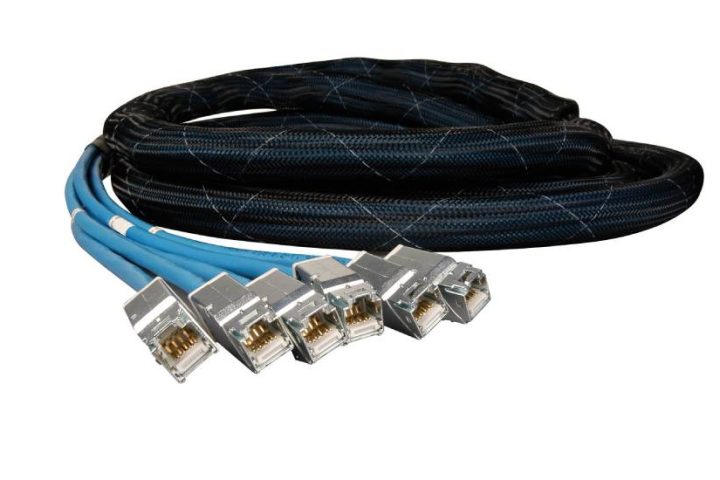
For cabinet-level connectivity, high-performance copper solutions remain relevant. Direct Attach Copper Cables (DACs) and Active Optical Cables (AOCs) offer lower cost with low power consumption, low latency, and ease of deployment in Top of Rack (ToR), Middle of Row (MoR), or End of Row (EoR) configurations.
In ToR environments, DACs up to 3 meters in length provide the best combination of latency and efficiency. They are ideal for latency-sensitive applications like AI, virtual reality, and high-speed financial systems. AOCs offer a great alternative for 10–15 meter links and provide greater flexibility where needed.
Notably, DACs can reduce port power consumption by up to 97% compared to traditional transceivers, offering both energy and cost savings at scale.
Scalability with built-In backward compatibility
DACs and AOCs are engineered for backward compatibility, supporting seamless migration from legacy SFP+ and QSFP+ interfaces to newer SFP28, QSFP28 and QSFP56 ports as well as QSFP-DD/OSFP form factors. This allows high-speed switches to maintain compatibility with existing server infrastructure until upgrades are required.
To avoid interoperability issues, it is critical to select solutions from vendors that rigorously test their DACs and AOCs across various switch platforms. Siemon even offers sample programs to validate interoperability before full deployment.
Partnering for performance and availability
Beyond technology, speed-to-market and supply assurance are just as crucial. Data centre professionals are advised to work with cabling partners that provide a globally integrated supply chain, local inventory hubs, and rapid-response to meet tight timelines. Providing instant support when customers need to scale their infrastructure is just as important. As a Solution Advisor in NVIDIA’s Partner Network (NPN) Siemon offers expert advice and consultation services to customers seeking to implement NVIDIA-based solutions or technology to address today’s data centre and AI challenges.
Data centre speeds are increasing, but bandwidth is not the only concern. Flexibility and future-proof performance are equally important. By adopting standards-based, future-ready connectivity solutions, infrastructure professionals can navigate complex migrations, reduce risks, and unlock new opportunities across cloud, AI, and enterprise networks.