


In March 2028, the MBR Explorer will leave Earth carrying a small passenger designed, built and tested in Abu Dhabi. From launch onwards, that probe will receive no further commands. It will spend 8 years and 5 billion km travelling with the spacecraft. In early 2036 it will separate above 269 Justitia, a red asteroid in the main belt, and fall towards a surface no spacecraft has ever reached.
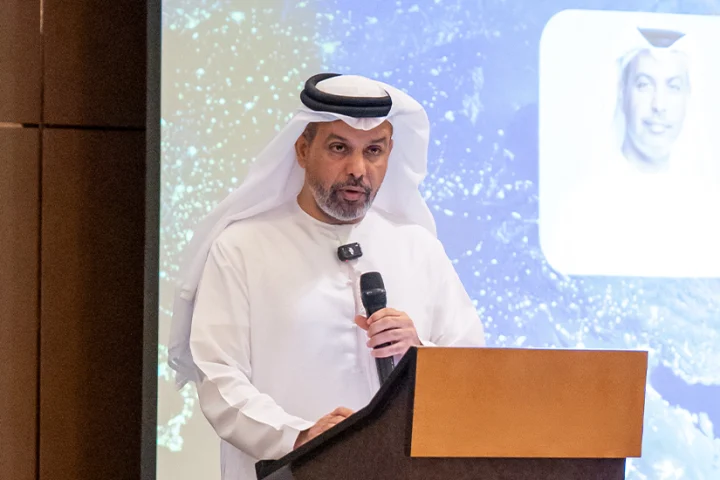
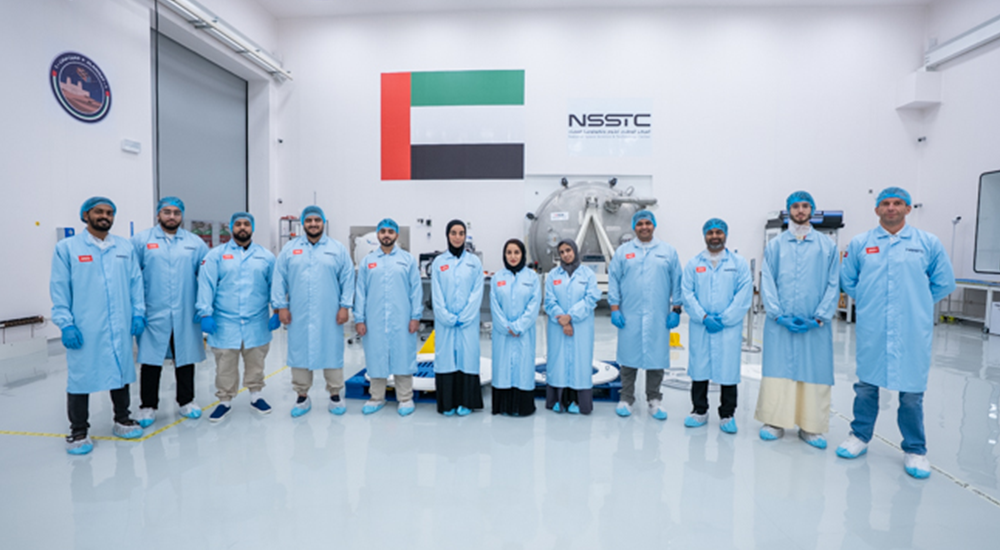
The Technology Innovation Institute (TII) showed the probe’s flight-identical qualification model at the Advanced Technology Research Council (ATRC) in Abu Dhabi this week. The flight unit is in thermal vacuum testing at UAE University in Al Ain. It will be shipped this month to the Laboratory for Atmospheric and Space Physics (LASP) in Colorado, where it will be integrated with the spacecraft.
Dr Najwa Aaraj, CEO of the Technology Innovation Institute, described the engineering limits in operational terms. “It will fly 8 years, and we have to trust that in these 8 years, I don’t have remote control to call it back,” she said. “Nothing can go wrong. And this is what we call rigorous engineering.”
A phone call in July 2024 set a deadline that launch physics would never allow to slip
Dr Anton Ivanov, Executive Director of TII’s Propulsion and Space Research Center, said the project started with a phone call in July 2024 asking whether his team wanted to build a probe. The mission’s spacecraft team in Colorado sent requirements in August. A consortium met in September. In January 2025, the UAE Space Agency and TII signed the development agreement before the Supreme Space Council, with His Highness Sheikh Hamdan bin Mohammed bin Rashid Al Maktoum present. Ivanov said his team used the photograph of that signing to speed up procurement and legal approvals.
A design milestone in July 2025 cleared the team to begin manufacturing. Intensive testing started in April 2026, and the hardware was due in September 2026. Ivanov said the team works its schedule backwards from launch because that date cannot move. “We don’t go on the spacecraft. We cannot get launched,” he said. Asked about funding, he said the project took 18 months from the moment money arrived. The mission’s total budget will be announced later.
The launch window lasts about 21 days, and the team confirmed there is no backup plan if it is missed.
AI on board is trusted to choose photographs while deterministic code keeps hold of the steering
Aaraj described the probe as one of the first to carry autonomy and AI inside it, and she was open about the tension that creates. “This is software, hardware, propulsion, autonomy, AI, which we know that AI is not deterministic,” she said.
During the question session, Ivanov explained how the team divides the work. “There are certain tasks on the spacecraft that we cannot have non-deterministic, for example guidance and navigation, and some other operations where we have to be extremely precise,” he said. “However, there are some operations where we can apply some judgement, and we can let the AI do it. For example, image selection.” He said the board would be the first from the UAE to carry an AI component into space. TII is also looking for a simpler low-Earth-orbit mission to test it on.
The board in question is the data processing unit (DPU). It is one of 5 boards in the probe’s avionics box and was designed entirely by TII. It sits between the 2 cameras and the onboard computer. Its job is to take in images, store them securely and wait for the command to send them to the main spacecraft. The engineering team said it runs a full Linux software stack and draws about 3 watts. It is fully redundant, down to a duplicated FPGA. TII plans to develop the DPU into edge AI hardware for aerial monitoring and defence use.
The descent gives the probe 2 to 3 hours and almost certainly ends on impact
The probe has no propulsion. The spacecraft will release it at about 1.2 m/s, and it will follow a ballistic path to the surface for 2 to 3 hours. During that time its attitude control system has to keep a wide-angle camera and a narrow-angle camera pointed at Justitia. The probe must also decide which of its images is best and send it back to the spacecraft. The team expects touchdown at 15 to 27 m/s and does not expect the probe to survive it. Even so, the battery has 20 to 50 minutes of reserve, so a probe that survives could still send its final data.
Justitia’s colour suggests it formed far beyond Neptune and holds material from the young solar system
Dr Elias Tsoutsanis, Chief Researcher at TII’s Propulsion and Space Research Center, said the team chose the asteroid for its colour. Justitia is redder than any other known asteroid, which points to an origin in the Kuiper Belt beyond Neptune. Tsoutsanis said it “might be a traveller from the past, from the early days when the solar system was forming planets”. Scientists hope it holds water-related minerals and organic compounds that show how these materials were spread through the early solar system. The asteroid’s orbit has only a modest tilt, which also saves fuel on a route that already includes 6 earlier flybys.
The route uses gravity assists from Venus, Earth and Mars. Aaraj said every component must cope with the heat near the Sun and the cold of the asteroid belt on the same voyage. The team will test the probe every 6 months during the cruise.
Officials measured the mission by the skills and suppliers it leaves in the UAE
His Excellency Faisal Al Bannai, Advisor to the UAE President and Secretary General of the ATRC, said sovereign technology needs a practical definition. “Having sovereignty means you know the tech, you’re able to evolve it, you’re able to change it, you’re able to use that knowledge in other missions, in other programmes that you want to develop,” he said.
Hamad Al Hashmi, Space Projects Manager at the UAE Space Agency and EMA Probe Manager, gave the numbers. The team had 55 members, 60% of them Emirati, and more than 25 UAE suppliers took part. Partners included Khalifa University and the National Space Science and Technology Center.
His Excellency Dr Ahmad Belhoul Al Falasi, Minister of Sports and Chairman of the UAE Space Agency, argued that deep space exploration pays for itself through what comes back down to Earth. “Today the camera on your phone is a byproduct of deep space exploration,” he said. He added that the Emirates Mars Mission had none of its hardware fully developed in the UAE, while this mission has a complete subsystem built in the country.
Engineer Mohsen Al Awadhi, Director of Space Missions at the UAE Space Agency, joined the Emirates Mars Mission in 2015 from an aviation background. He said the agency would choose future work with clear capability targets in mind. “The next programme, we can see the propulsion subsystem should be developed fully in the UAE, and we take it a piece every single mission that we move forward,” he said.
Belhoul said the probe would ship within days. If it works, the result will reach Earth in 2036, sent back by a machine that has spent 8 years following code written in Abu Dhabi.