



“If you had asked me 20 years ago whether I could carry my music library, my films, a world of possibilities in my pocket,” Tanuja Randery told an audience at the Dubai World Trade Centre this week during the AWS Summit, “I would have said no.” Randery, Vice President, EMEA at Amazon Web Services (AWS), was marking 20 years of the cloud business that put that world in people’s pockets, and the business rested on a promise that customers would never have to think about the buildings underneath it, because data spread across separate availability zones would survive the failure of any one of them.
This year, in the UAE, that promise met physical force. On 1 March, drone strikes hit two AWS facilities in the country, starting a fire and forcing emergency crews to cut the power, while a strike near a facility in Bahrain damaged infrastructure there as well.
On 15 September, AWS told customers that the damage in Bahrain had exceeded what its services were designed to withstand, and that data stored only in mec1-az2, 1 of the 3 availability zones in its UAE region, could not be recovered.
This however, hasn’t deterred AWS – it in fact has committed up to AED 20 billion to the UAE through 2036. Randery’s keynote, delivered about two weeks after the company confirmed those losses, made the case for holding that bet, and the evidence she chose, from a ride-hailing app AWS helped keep running through the strikes to a national adoption survey, shows how the company reads the market it has refused to retreat from.
Careem stayed through the strikes, and then went deeper
“And across the UAE, there are businesses that are not waiting,” Randery said, and the first she named was the one whose story bore most directly on this year’s disruption. Careem, which she called “the region’s Everything App”, runs more than 1,000 microservices and 600 databases on AWS for over 75 million customers and 3.5 million captains, and it had to keep running through the months the region was under attack.
“This year, when the region faced its most challenging period, our teams worked alongside Careem’s engineers to keep their services running for the people who depend on them,” Randery said.
Careem has since committed its generative AI workloads to Amazon Bedrock, putting its entire technology stack, from infrastructure to AI, on AWS. “That is the kind of trust and momentum that tells you where this industry is heading,” Randery said.
The decision does more for AWS’s AED 20 billion bet than any survey figure, because it came from a customer that watched its cloud provider’s local infrastructure take a direct hit and chose to build further on it.
The customer numbers impress, and none of them comes with a baseline
RAKBANK, one of the country’s oldest banks, rebuilt its digital banking platform on AWS from the ground up in under 9 months after concluding that migration alone would not do. “They recognised that their digital future couldn’t be built by simply lifting and shifting to the cloud,” Randery said. The bank’s AI platform, Rai, has since handled 1.8 million conversations, according to AWS, resolving 74% of chats without human intervention at a 96% customer satisfaction score. None of those figures came with a launch date or a comparison with performance before Rai, so they prove scale more convincingly than improvement.
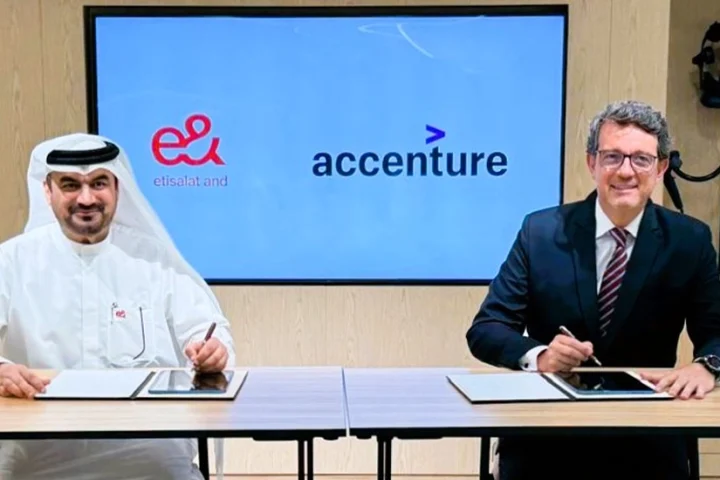
e&’s AgNext, which Randery called “one of the most compelling examples of AI-first transformation in our region”, lets business users build, orchestrate and govern AI agents without writing code, drawing on the operator’s telecoms, mobility, IoT and voice data for tasks from KYC checks to procurement. AWS credits it with “up to 90% reduction in manual processes”, a ceiling figure with no average attached. e& plans to sell AgNext across Asia, the Middle East, Africa and Europe, a move that would turn a UAE telecoms operator into an exporter of enterprise AI software.
Adoption has spread fast, and depth has not kept pace
Careem, RAKBANK, and e& are the exceptions that Randery’s own report describes. “72% of businesses in the UAE have now adopted AI, up from 53% last year,” she said, launching Unlocking the UAE’s AI Potential 2026, a report produced by Strand Partners for AWS in collaboration with the UAE Artificial Intelligence Office. AWS presents the 19-point rise as 36% year-on-year growth, and Randery qualified it at once. “But the UAE is more nuanced than that headline suggests,” she said.
Only 31% of adopters have reached advanced use, where AI reshapes business models, creates new products and runs agentic systems, which equates to roughly 1 in 5 UAE businesses overall. Some 48% of organisations name skills shortages as a major barrier to going further. Randery said the challenge now “is about execution”, the move from pilots to production that most UAE companies have yet to make.
AWS says it has invested more than $15 billion in the region since opening in Bahrain in 2019 and the UAE in 2022, and it estimates its UAE commitment will add AED 41 billion to the national economy and support 6,000 local jobs a year. Randery said infrastructure meant “creating the foundations that allow organisations to innovate with confidence”, a claim the March strikes had already put to the test.
A $1 billion alliance with e& produced the UAE Sovereign Launchpad, a cloud platform endorsed by the UAE Cybersecurity Council and now available to government, financial services, healthcare and energy customers. With HUMAIN, AWS is building a $5 billion AI Zone in Saudi Arabia, and in December it opens a Saudi region backed by $5.3 billion of investment. This year it also launched a 38,000-title Digital Arabic Library with the Abu Dhabi Arabic Language Centre and a government-backed cybersecurity accelerator that aims to support more than 500 startups.
Skills will decide whether the 31% grows
“Technology alone is not enough,” Randery said, calling the closure of the digital skills gap a prerequisite for scaling AI. AWS says it has trained more than 680,000 people across the Middle East, North Africa and Türkiye and will reach 2 million by 2030.
In the UAE, that includes a free computing curriculum for universities through AWS Academy, AI and cybersecurity training for public sector staff with the Abu Dhabi Department of Government Enablement, and 30,000 places on the AI Nation Afaaq programme with e&, which offers free training, coaching and sponsored certifications. Places on a programme measure intent, and completion rates, once published, will say far more about whether the gap is closing. “Because if the UAE is going to realise its AI ambition, the people building that future need to have the skills to do it,” she said.
The restoration statement left the hardest questions open
Randery addressed the damage only after the Saudi announcement, repeating an update given earlier in the day by Chris Erasmus, Managing Director for AWS, UAE and MENA Growth Markets. “We are actively working to replace the affected infrastructure in the region, and we will provide an update on the restoration of our services in the coming months,” she said, adding that AWS was “committed to coming back stronger”.
The statement gave no restoration date and said nothing about customers whose data in mec1-az2 is gone. For UAE enterprises moving AI into production, the strikes have turned resilience into a design decision: how many availability zones a workload spans, whether backups and encryption keys sit outside the damaged facility, and whether data sovereignty rules leave room to fail over abroad when a local region goes dark.
Careem has already decided to stay and build, and the update AWS has promised for its UAE region, due in the coming months, will show how many other UAE businesses are ready to do the same.