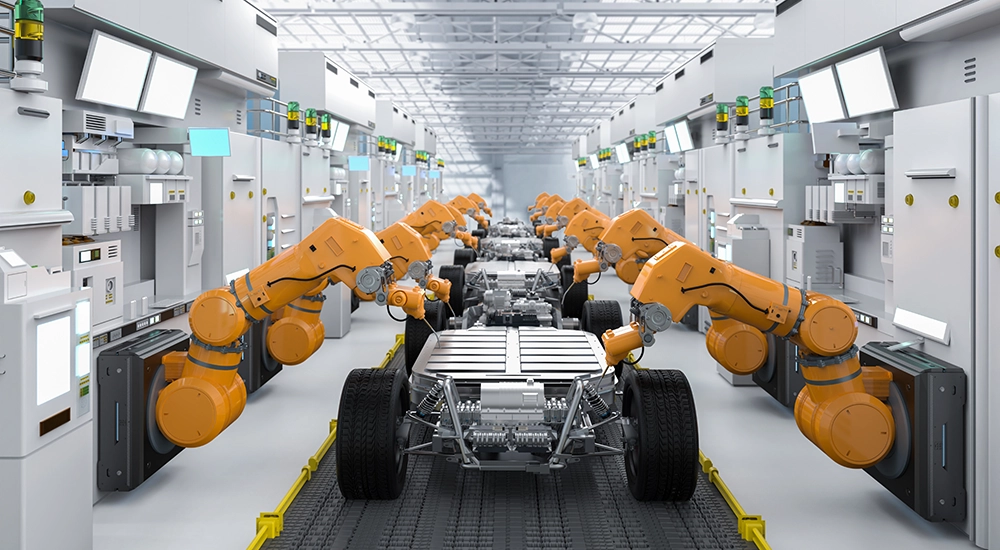




In the industrial space, IFS connects engineering, production, asset management, field service, project execution, through a unified digital thread on a single cloud platform. IFS is also purpose-built for industries and is not a horizontal ERP player. High growth requirements are pushing industrial enterprises to modernise and this is an inflection point where IFS is playing a role.
As an organisation, IFS is 40+ years old and began its journey in the industrial space. Over the years IFS has continued to keep its focus in industrial segments.
For the fiscal year ending December 31, 2025, IFS reported an Annual Recurring Revenue of €1.24B growing by 23% year-on-year. With 83% of revenue now recurring, IFS has established a stable and predictable revenue base.
IFS serves a diverse range of vertical markets with integrated, AI-powered software solutions tailored to industry-specific needs. Key sectors include aerospace and defence, construction and engineering, energy and utilities, manufacturing, telecommunications, and service providers.
Across these industries, IFS connects critical functions such as engineering, production, asset management, field service, and project execution on a unified platform. This enables organisations to enhance operational efficiency, reduce costs, and ensure regulatory compliance.
IFS products encompass IFS Cloud, Field Service Management, Enterprise Asset Management, Enterprise Service Management and Enterprise Resource Planning. At the core is IFS.ai, designed to bring industrial AI into real-world operations using machine learning and historical data.
Key regional enterprise customers include International Maritime Industries Company, Saudi Electricity Company, Aircrafts Accessories and Components Saudi, Dubai Drydocks, Saudi Telecom Company, Wahaj – Saudi Advanced Technology Company, Port of Duqm, Port of Sohar, Tracker Connect, Emirates Airlines, and others.
“The momentum to become an AI first player in the industrial space has gathered a lot of steam, with more and more investments. And it is deliberate; it is by design,” says Rahul Misra, Senior Vice President and Managing Director MEA, IFS.
IFS has been centred around the asset and service industry and because of that it has gathered much of its industry and domain knowledge, while its technology has become cloud centric.
“The journey to cloud for our customers and for our partners, and then leveraging Artificial Intelligence is just a natural progression,” says Misra.

Market differentiation
The differentiation that IFS brings is important, and covers industry knowledge, technology, and the fact that you can contextualise all of them together. IFS’ differentiation lies in combining industry knowledge with technology and contextualising both within operational environments.
According to Misra, AI on its own, on the periphery or laying it over in a technology layer, does not bring value without context.
“You need to have industry context, you need to have an understanding of nuances, and the ability to embed and operationalise AI to derive meaningful outcomes. This is where IFS stands apart.”
“We are not a horizontal ERP platform and this is our clear differentiation. It is what we are doing day in and day out,” Misra continues.
With IFS, enterprises do not need a monolithic platform to generate a return on their investments. IFS has one platform to help enterprises acquire, visualise, conceptualise, and run their investment planning. This is a digital thread that runs from the boardroom to the operational switchboard and runs on one platform.
“There is nobody who delivers this as one integrated capability across the full lifecycle, from cradle to grave,” reflects Misra.

Customer pain points
Industrial enterprises are facing multiple pain points. Aging infrastructure, often tied to legacy technology systems, leads to high downtime costs due to limited predictive capabilities. At the same time, skills shortages and system obsolescence restrict innovation and scalability.
“So they are bound by both and that leads to a high cost of downtime because you are not able to run a predictive environment,” says Misra.
Supply chains have grown increasingly complex, further impacted by geopolitical dynamics over the past 12–18 months. Sustainability and regulatory compliance are also rising priorities across industries globally and regionally.
In parallel, GCC countries such as the UAE, Saudi Arabia, Qatar, and Oman are experiencing rapid post-pandemic growth, putting pressure on infrastructure and increasing demand for modernisation.
“If these economies want to grow, they need to modernise,” explains Misra. This is the inflection point where IFS is playing.

Technology acquisitions
IFS continues to invest in both technology and talent to deliver more relevant and contextual customer use cases.
In August 2024, IFS acquired Copperleaf, a leader in decision analytics. This strengthens IFS’ asset investment planning capabilities, enabling organisations to optimise capital allocation, manage risk, and make data-driven decisions.
Copperleaf enhances board-level planning by allowing enterprises to visualise and optimise large-scale capital investments across the asset lifecycle, from build and operate to maintain and retire.
Copperleaf is meant for asset investment planning and sits with the board for capital planning. It enhances the ability of the board and stakeholders to visualise millions and billions dollars of investments.
“You cannot get it wrong and you have to get it right and you have to get it right on most occasions. You need to know when and where to optimise that investment. AIP and the IFS cloud platform runs together,” continues Misra.
In October 2025, IFS introduced the next evolution of its IFS Loops platform, featuring Agentic AI-powered digital workers.
These digital workers autonomously manage complex workflows such as field dispatch, supplier coordination, order management, and inventory replenishment, operating across enterprise systems with real-time intelligence and compliance.
Unlike traditional automation or RPA, they make context-driven decisions and continuously improve performance while working alongside employees.
IFS Loops also serves as an entry point into Agentic AI, with IFS Loops Studio from Q1 2026, enabling customers to create their own digital workers through rapid customisation.
In March 2026, IFS completed the Softeon acquisition, expanding into warehouse management. This was followed by the launch of IFS.ai Logistics, which unifies planning, execution, freight audit, and network optimisation into a closed-loop logistics platform.

Integrating AI and domain knowledge
IFS has a set of data scientists who understand customer problems and, compliment that with industry knowledge. They help to make use cases generic over time because as they evolve, patterns can emerge.
At the operational level, AI is embedded directly into workflows, not layered on top. Agentic AI acts as an enterprise twin, capable of making decisions within defined boundaries by learning from data and operational patterns. This helps reduce system stress and compensate for ongoing skills shortages.
“We have got AI embedded in the operational workflows and it is all intertwined and tightly in place. You do not have a separate layer sitting on this because you wrap it to handle your moments of service.”
IFS follows an ecosystem approach, working with partners such as Boston Dynamics and Anthropic, while remaining technology-agnostic.
“Our approach is simple, solve customer problems. That is where the value lies,” he adds.

Channel partners and alliances
In April 2026 IFS announced a new pricing model that fundamentally changes how enterprise AI is bought and deployed. Organisations now have the freedom to deploy Industrial AI wherever it creates value, without constraint, and without the fear of escalating costs. It is based on assets and not headcount.
To have the ability to serve industrial enterprises, it is necessary to include system integrators or channel partners who have the domain knowledge of industries and how assets work in those industries.
“Earlier we did not have an Accenture or a PwC or a Deloitte. Over the last six to eight months, we brought in specialists from the rest of the world,” explains Misra.
To boost its partner programme IFS is adopting a two-fold strategy. The first is working with global system integrators who manage large scale business transformation engagements and bring in domain expertise. The second is working with market aligned channel partners who manage implementations and solutions.
The customer has the choice of selecting which channel partners to work with and can sometimes work with both types of partners.
In the Middle East and Africa, IFS is partnering with Accenture, PwC, Deloitte, alongside strategic technology players like Microsoft, Tech Mahindra, and Tata Consultancy Services.
IFS is now moving toward a partner-led model, aligned with its AI-first strategy and centred around customer outcomes.
Whether enabling smarter asset management, improving operational efficiency, or driving transformation programmes, partners play a critical role in extending the value of IFS.