


A commissioned study by Bentley Systems and Verdantix reveals a significant gap between infrastructure resilience goals and operational reality. While 80% of organisations have resilience strategies, fragmented data silos prevent effective implementation. Consequently, over 70% of firms plan to increase investment in digital twins and AI to combat climate-related threats and improve predictive insights.
The research shows that while infrastructure resilience is a strategic priority, fragmented data and siloed digital systems are preventing organisations from generating the predictive insights needed to reduce infrastructure vulnerabilities, especially climate-related threats. As a result, many infrastructure owners and operators are increasing investments in digital twins and artificial intelligence (AI) to strengthen resilience and improve decision-making.
Amit Prothi, Director General of the Coalition for Disaster Resilient Infrastructure (CDRI), who authored the report’s foreword commented, “As climate-driven disruptions become more frequent and interconnected, infrastructure resilience must move from policy ambition to operational reality. Investments in risk-informed planning, data systems, and digital capabilities can significantly reduce the cascading impacts of infrastructure disruptions. Building resilience requires a system-wide approach.”
The report, Beyond Reactive: How Digital Intelligence Is Enabling Infrastructure Resilience for a Climate-Disrupted World, includes insights from senior executives across large-scale energy, mining, transportation, and water organisations worldwide. It highlights the need for infrastructure owners to move beyond monitoring individual assets and toward managing interconnected systems and networks. To support this transition, the report identifies open digital twins as a critical enabler that brings together operational, environmental, and risk data to improve visibility and insights.
Key Findings from the Report
- More than 80% of infrastructure organisations report having mature or developing resilience strategies, yet many struggle to translate strategy into action due to technology and data limitations. Despite this commitment, the execution gap persists as digital and operational constraints prevent effective implementation.
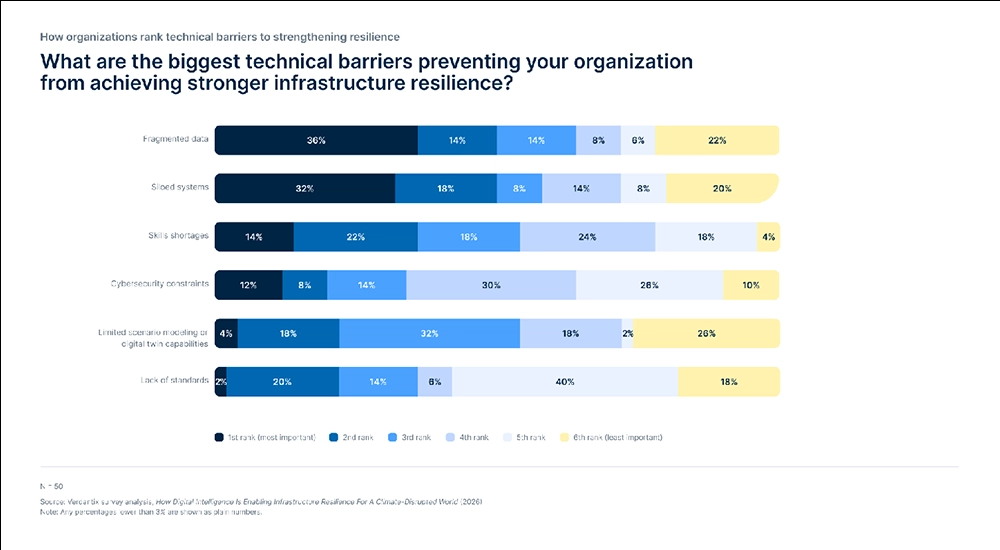
- More than two-thirds of respondents cited fragmented data and disconnected digital systems as their top two technical barriers to improving resilience. This limits visibility across assets, networks, and climate-related risks, preventing organisations from developing a unified operational view.
- More than 70% of organisations plan to increase spending on digital twins over the next 24 months, while AI is already delivering measurable value. Half of respondents use AI for inspections, and more than 40% have implemented AI-powered failure prediction capabilities, signaling a shift toward predictive operations.
Adding context to these findings, Priyanka Bawa, Principal Analyst at Verdantix, said, “The research highlights a fundamental operational challenge. While most organisations have a resilience strategy in place, their digital systems are rarely integrated enough to execute it. When critical information remains siloed, infrastructure owners cannot accurately assess complex network vulnerabilities or demonstrate the clear return on investment necessary to secure future funding.”
Speaking during a panel discussion at London Climate Action Week, Chris Bradshaw, Bentley’s Chief Sustainability and Education Officer, noted, “Infrastructure professionals already collect much of the data needed to understand climate-related risks. The biggest barrier is fragmentation. Open digital twins help address this challenge by bringing disparate data sources into a single, accessible environment. This integration enables engineering teams to move from reactive maintenance toward predictive insights and more proactive, long-term resilience planning.”