



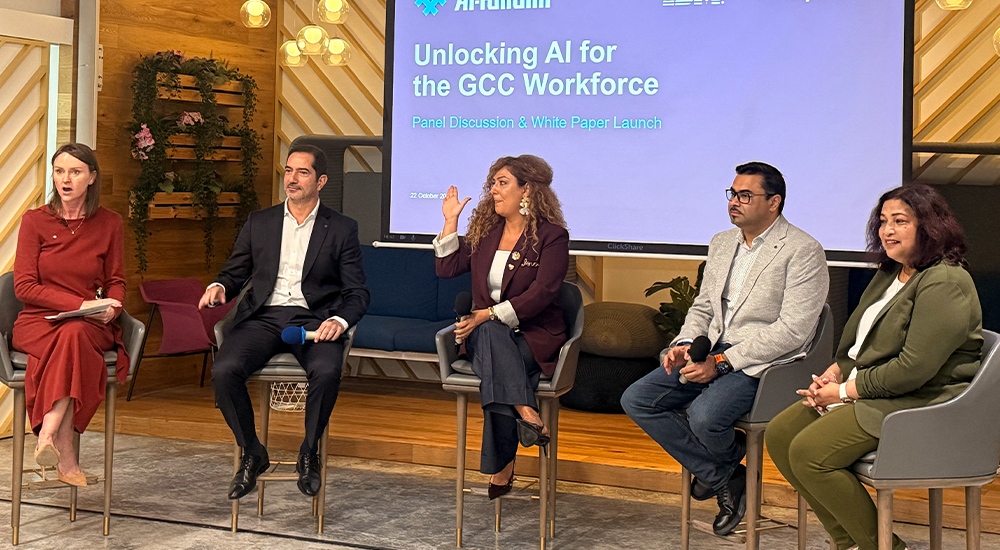
The GCC’s consumer-facing businesses have a measurable gap between how often their employees use AI and how well they are equipped to use it. Until that gap closes, the productivity gains companies report will struggle to reach customer service, decision-making or the bottom line.
That is the central finding of Unlocking AI for the GCC Workforce, launched in Dubai this week by Al-Futtaim with IBM and Inception42. The survey, carried out with YouGov in March, covered 1,143 professionals across six GCC markets, most of them in the UAE and Saudi Arabia, working in automotive, retail, healthcare, hospitality, consumer goods and IT.
Adoption is already high. Eighty-two per cent use AI at least once a week and 34 per cent use it daily. Seventy-three per cent say it has improved their productivity, and 35 per cent save four or more hours a week, with one in eight saving more than six. Readiness is a different story: only 39 per cent feel extremely confident using AI, a figure the paper puts 43 points below usage. Fifty-three per cent of employees say their organisation actively encourages AI, yet only 20 per cent have received extensive training, a third basic training, and one in four none at all.
The paper calls this the readiness paradox. Eighty-seven percent of respondents can link their AI use to measurable results, which means many are producing work with tools they do not fully trust and cannot always evaluate.
Training is the strongest predictor of results
The data points to training as the most important variable. Extensively trained employees are 2.5 times more likely to feel highly confident than untrained peers, twice as likely to save four or more hours a week, and 1.3 times more productive. Forty-five percent of extensively trained respondents report high confidence, against 18 percent of those with no training, and 81 percent report productivity gains, against 59 percent.
Hesham Ikhwan, HR Director at Al-Futtaim Retail and Automotive, said the group learned that a training programme alone does not change behaviour. When it began its AI programme three years ago, it launched an academy with curated content and reached a 70 percent participation rate.
“People used it, people are comfortable with it, but we didn’t see a lot of shift,” he said. “It wasn’t until we did the role-based training, and started talking to people about how AI can help them, that we started shifting the needle.”
The turning point came when the team dropped the technical vocabulary. In Saudi Arabia, it sat with store managers and discussed their daily business problems in Arabic and in plain language, without mentioning large language models.
“You can see the engagement with the people and the fear level drop, because people started asking and engaging with questions,” Ikhwan said.
He linked lasting habits to job security. Part of the work, he said, is telling staff that “this particular job that you’re doing in the shop may go away, but the skills you are going to learn in the process will actually make you much more employable for the future.”
The frontline, older workers and small firms are least equipped
The paper’s most striking finding concerns who gets trained. Extensive training falls from 36 per cent at senior leadership level to 8 per cent at the frontline, and 42 per cent of frontline and junior staff have received no training at all. Seventy per cent of C-suite respondents have received formal training, against 32 per cent of frontline staff. Forty-eight per cent of C-suite respondents feel highly confident using AI, compared with 25 per cent of frontline workers.
Those are the employees closest to customers, and the data shows it. Customer service ranks as an area of AI impact for only 20 per cent of respondents, even though it is the core of the consumer economy. Roundtable participants described AI as currently helping people move faster rather than serve customers better.
Two other groups are being left behind. Forty-seven per cent of workers aged 45 and over have received no formal AI training, the highest rate of any age group, even though they hold much of the institutional knowledge and client relationships. Only 31 per cent of professionals in firms with fewer than ten employees have been trained, compared with 72 per cent in firms of 250 to 999 people. The paper concludes that AI investment is flowing to where it is easiest to deploy rather than where it is most needed.
Leaders set the pace
Leadership behaviour has an outsized effect. Where senior leaders actively use AI themselves, employee adoption is three times higher. In organisations with a formal AI strategy, employees are more than twice as likely to receive role-specific guidance, and the share reporting high confidence nearly doubles.
Rima Semaan, Director of AI and Enterprise Solutions at Microsoft, connected this to Microsoft’s AI diffusion research, which ranks the UAE as the most AI-diffused country among the working-age population.
“It is a leadership-led transformation, top down. Leaders are role models to their employees while they’re using and adopting AI at scale,” she said.
She warned against shortcuts. “Please do not sprinkle agents and AI into every business process and assume that it will perform better,” she said. Her advice was to redesign one process end to end with humans at the centre, then move on to the next. She also identified critical thinking, judgment and management as core skills. “Whether you are a frontliner or a CEO, there will be some AI processes that you need to manage,” she said.
In the white paper, Semaan argues that individual skill will soon stop being the main constraint. She cites Microsoft’s 2026 Work Trend Index, which finds that only around one in four employees report clear and consistent leadership alignment on AI, and describes this as a “transformation paradox,” in which “workers are ready, but the systems around them are not.”
Technology is the easy part
Himanshu Shrivastava, Chief Technology and Data Officer at Al-Futtaim, summarised the group’s experience as T²P²: technology, trust, people and process. Technology is no longer the limitation, he argued. Trust is harder in a group spanning regulated entities and divisions with different risk appetites.
He said Al-Futtaim’s response has been to build security and governance into the platform from the start. “Security by design, trust by design, governance by design is very crucial,” he said. “People don’t have to ask me if this platform is secure. It’s my default behaviour.” Without that, he added, “doubts will start coming up. When doubt starts coming up, adoption goes down.”
The survey supports his focus. Data security is the leading barrier, cited by 36 percent of respondents, ahead of lack of training at 25 percent and time pressure at 24 percent. The concern stays flat regardless of how much training people have received, which the paper reads as a governance problem that skills alone cannot solve.
Asked what he would have done differently, Shrivastava said, “Process reimagination is the biggest problem. We started it mid-year last year. This should have been there on day one.” He makes the same argument in the paper, writing that the move towards agentic AI raises the stakes on process and mindset, and that “most organisations are prepared to invest in the technology. Far fewer are prepared to do that harder work.”
What companies are willing to let go
Lula Mohanty, Managing Partner for the Middle East and Africa at IBM Consulting, said most organisations have bolted AI onto workflows designed for another era. The shift comes, she said, “when companies stop asking how to accelerate efficiency, and start asking: if I were to rebuild my organisation with the technology that’s available today, what would I design differently?”
Her sharpest point concerned the fallback processes that most companies keep in place.
“The real test of seriousness around AI ambition is not just what you want to invest, but what you’re willing to let go,” she said. That should begin with high-confidence use cases that solve real pain points, she added, but keeping an AI-free backup means “you’re operating two models. That doesn’t work.” The paper supports this, noting that organisations that scaled fastest typically made the old process unavailable rather than optional.
IBM’s own experience informs that view. In the paper, Mohanty writes that, as its own first client, IBM has generated more than US$4.5 billion in productivity gains from over 155 AI use cases across HR, IT, procurement, software development, sales and operations. She describes the lesson as a “10:20:70 rule,” in which technology accounts for 10 per cent of success at scale, process redesign 20 per cent, and people enablement 70 per cent.
Ibrahim Al Jallaf, Chief Operating Officer at Inception42, makes a similar argument in the paper, pointing to ADNOC, where more than 115 agents now run across HR, finance, procurement and auditing and 20,000 employees have been trained to build and supervise their own agents. Workforce training, he writes, “is not a cost line.”
A people problem with a governance floor
The paper’s recommendations follow from this: stop buying more tools and use the ones already in place, give AI a shared home across business, technology and people functions, redesign workflows rather than add AI to them, train for specific roles, fix data foundations, and measure outcomes such as error rates, decision speed and customer satisfaction rather than usage alone.
Asked from the floor how responsible-AI frameworks can keep up with releases every few weeks, the panel agreed that foundations must outlast any single tool. Semaan urged organisations to “treat security and responsible AI as a living thing,” while Ikhwan said employees also need to be trusted to use their own judgment within clear guardrails.
Asked what they would change in hindsight, Ikhwan gave the most candid answer. “We underestimated the human change and transformation that is needed, and we put all our eggs into getting the AI and the tools,” he said.
In her foreword to the paper, Moza Al Futtaim, Chief AI Officer at Al-Futtaim, makes the same point, arguing that the gap between using AI and being ready for it “is not technical. It is human.” The survey suggests much of the region is in the same position. Access is no longer the problem. The next round of value depends on whether companies invest as much in the people expected to use AI, particularly those on the shop floor, as they have in the tools.