

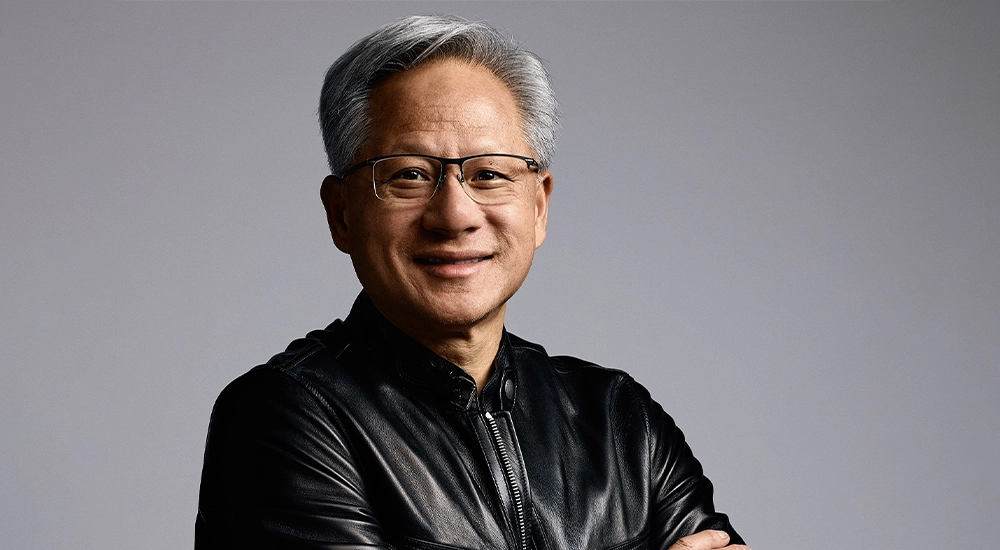
Jensen Huang, CEO, NVIDIA has announced partnerships with six of the world’s largest asset managers and investment banks to create independent financing platforms for AI infrastructure, structures the company says are designed to mobilise more than $500 billion of third-party capital over time.
The partners are Apollo, BlackRock, Blackstone, Brookfield, Goldman Sachs and KKR. Under the arrangement, the financial institutions will underwrite each project independently, assessing the customer, expected demand, utilisation, cash flow and residual value. NVIDIA’s contribution is the AI factory platform itself, not the funding.
Huang in his note on the social media platform X said the $500 billion figure represents aggregate capital the platforms are designed to raise over time. It is not NVIDIA revenue, a single fund, or a commitment to any one customer.
From project financing to infrastructure financing
NVIDIA is positioning the move as a shift in how AI capacity gets built, from companies buying chips and constructing data centres one project at a time, to compute being financed the way roads, grids and telecom networks are financed. “In AI, compute is revenue,” the company said in a post published alongside the announcement.
The pitch to investors rests on four claims: that AI factories generate revenue, serve a broad market, improve over their lifetime through software, and can be redeployed to a different customer or operator if demand shifts.
Central to the case is the assertion that NVIDIA hardware holds its value longer than a standard depreciation schedule assumes. The company pointed to the Ampere-based A100, launched in 2020 and still in commercial use six years later for training, fine-tuning, inference and HPC work, with customers continuing to commit to multi-year deployments.
NVIDIA also cited rental pricing as evidence. One-year H100 contract pricing rose from roughly $1.70 per GPU-hour in October 2025 to about $2.35 in March 2026. Median on-demand pricing across providers moved from around $2.00 to $2.70 per GPU-hour over the same period through June 2026. Blackwell-generation B200 capacity is being quoted at approximately $5.30 to $7.05 per GPU-hour.
The company said CUDA and successive software releases raise the output of already-installed systems, extending the economic life of the asset.
Addressing the circularity question
NVIDIA used the announcement to respond directly to accusations of circular
financing, a charge that has followed several of its investments in AI companies that in turn buy its chips. Bringing independent institutional capital into the market, the company argued, is the answer to that concern rather than an example of it.
It did disclose one form of exposure – in some cases NVIDIA may provide a residual-value support mechanism covering up to 25 per cent of an opportunity, assessed project by project. The company described this as lower than comparable compute-financing arrangements and said it is meant to complement independent underwriting rather than substitute for it.
The platforms are aimed at AI labs, enterprises, cloud providers and countries building national AI services. That last category is directly relevant across the Gulf, where sovereign-backed operators are building large-scale capacity and where the constraint has increasingly been financing structure and power availability rather than access to hardware.