

Vertiv has agreed to acquire UtilityInnovation Group (UIG) for approximately $1.45 billion to enhance its microgrid and power architecture capabilities. The deal aims to accelerate power availability for AI data centres by extending Vertiv’s portfolio to include grid interconnects and onsite energy storage orchestration.
At the approximately $1.45 billion purchase price, the acquisition represents approximately 13x expected UIG 2027 EBITDA. The EBITDA multiple is anticipated to be significantly lower if the full earnout is paid. Vertiv expects the acquisition to be accretive to adjusted earnings per share in the first year following completion. Strategically, the acquisition extends Vertiv upstream to the grid interconnect, adding microgrid controls, onsite generation and energy storage orchestration, and behind-the-meter power architecture. These capabilities are expected to help data centre operators secure power faster as grid constraints increasingly limit AI infrastructure deployment.
As power availability becomes a more critical factor in data centre development, architecture decisions are moving earlier in the planning process. Microgrid systems can coordinate onsite generation and energy storage, reduce reliance on utility power and support the grid when needed. This is expanding the importance of power architecture at the earliest stages of site development, when decisions can have significant implications for downstream infrastructure.
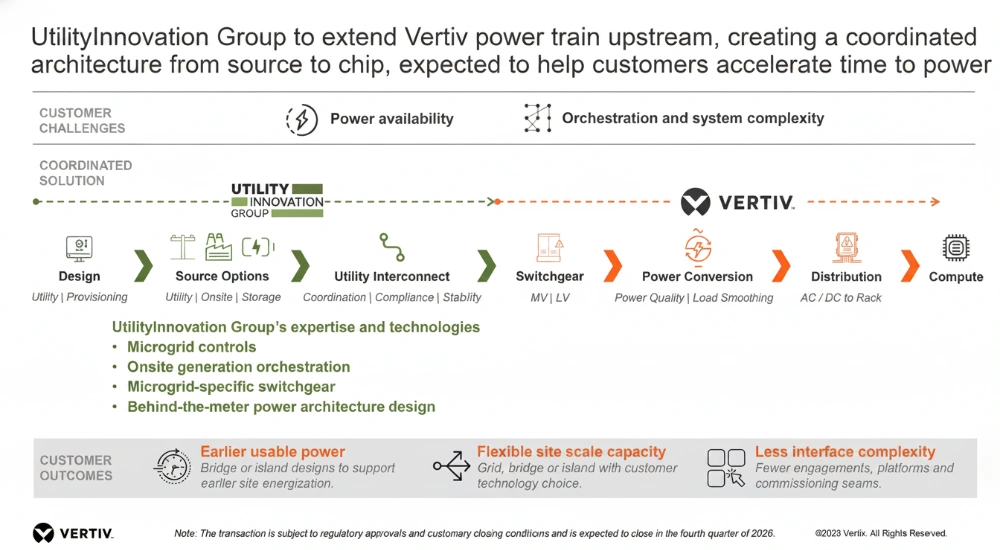
“For AI data centre operators, competitive advantage increasingly depends on how quickly they can move from site selection to first token,” said Gio Albertazzi, Chief Executive Officer, Vertiv. “Vertiv has the most complete power and cooling portfolio in the industry. With UIG, we anticipate extending that portfolio upstream to the utility interconnect and onsite power sources, creating a coordinated architecture from source to chip without tying customers to a single generation technology or supplier.”
Albertazzi continued: “Together, we anticipate being better positioned to support grid-connected sites, bridge-to-grid deployments and islanded sites supplied by onsite generation, while reducing complexity from site planning through rack-level deployment. This broader capability can help customers accelerate time to power and, ultimately, time to first token.”
UIG Founder and CEO Sidney Hinton added: “UIG was founded to solve increasingly complex power challenges for data centre operators through flexible, technology-agnostic architectures. Vertiv’s global scale, critical infrastructure portfolio and service capabilities make it a strong strategic fit for what we have built. We believe this combination can expand the reach of UIG’s microgrid controls and power architecture expertise and create greater value for customers as power becomes an increasingly critical constraint on data centre growth.”
Expanding Vertiv’s Onsite Power Capabilities
UIG’s expertise and technologies complement Vertiv’s existing offerings:
- Experience: Design and delivery of microgrid systems for AI data centre operators across the United States and Europe, supported by extensive utility relationships and experience with complex, large-scale deployments. UIG’s designs are generation-agnostic, allowing architectures to be built around the technologies a site can permit, fuel and finance.
- Expertise: Behind-the-meter power architecture design that engages customers at the earliest planning stages, before equipment is selected. This enables Vertiv to help define the power blueprint that shapes downstream infrastructure decisions, supported by pre-validated reference designs for grid-connected, bridge-to-grid and islanded sites.
- Technology: Proprietary controls platform and pre-engineered microgrid switchgear that orchestrate multiple power sources in real time and coordinate them with the critical power train.
Today, Vertiv brings deep systems and controls expertise across the critical power train, supported by an end-to-end power and cooling portfolio and global service network. Combined with UIG, Vertiv expects to help customers design and deploy integrated power architectures that improve speed, resiliency, efficiency, and flexibility.
Expected customer and operator benefits include:
- Faster access to power with less dependence on utility interconnection timelines
- Ability to scale site capacity beyond what the grid alone can provide
- A single accountable relationship from grid interconnect through rack-level infrastructure
Together, these capabilities are expected to give customers greater flexibility in how they source, manage and scale power as data centre requirements evolve.